








What is the Most Secure Lock To Prevent Lock Snapping? (2025 Guide)
When it comes to home security, we often overestimate the quality of our locks. Most of the time, we assume that our locks are strong enough that nobody is going to try and break in. It is easy to imagine that lock breaking is often carried out through sheer brute force, but that is not the case. Thanks to a technique known as lock snapping, even entry-level criminals can gain access to your home in a matter of minutes.
Lock snapping is not uncommon, either. Statistics in recent years have found that around 8% of home burglaries involve entry via lock snapping. While lock snapping has been shown to be in consistent decline over the last decade or so, complacency is the enemy of safety. If you worry about lock snapping, then you should read on through this comprehensive guide. Inside, we will cover the basics of lock snapping as well as the easiest ways to avoid becoming a victim of this method of entry.
Lock Snapping: At A Glance
So, lock snapping – sometimes known as cylinder snapping – is a form of illegal entry through your door. If a door has a lock type known as a Euro lock cylinder, lock snapping allows piece-of-cake entry for a criminal with the right tools. This is not an overly sophisticated method of entry, either; lock snapping requires a few precious tools.
Most domestic homes in the UK have Euro cylinders in their door locks, especially if they have uPVC doors. Composite and aluminium doors in the UK also have a large number of Euro lock cylinders. Even in some businesses, we have found this lock type. So, the lock type that is most prone to lock snapping remains one of the most commonly used in the UK. Can you see the issue here?
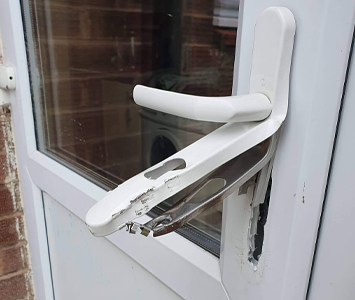
The actual process of lock snapping involves someone breaking the lock’s cylinder. The lock then becomes much easier to open, meaning that someone can open it from the outside. Once the cylinder is broken, precious little resistance remains within the door itself. The cylinder is the key point of your door lock system; once the cylinder is taken out of the equation, breaking in is easy.
Ironically, the cylinder is also the weakest point of the door lock system. Once broken through, though, the rest of the system becomes little more than an irritant. The danger of lock snapping is that it takes less than twenty seconds for someone to carry out the job, and it requires precious little in the way of specialist tools.
While in recent years, less than 1 in 10 break-ins involve lock snapping, it is still a common form of entry. The rise in anti-snap locks means that many burglars are no longer quite so confident of pulling off this trick. Thanks to a rise in awareness, too, people are more aware of the signs of lock snapping and thus remain more vigilant. The prominence of CCTV and smart security, too, means many lock snappers no longer feel quite so confident engaging in such activity.
The Secret To Stopping Lock Snapping? Anti-Snap Locks
So, we hope that you do not feel too worried having read the above!
Yes, lock snapping is a serious concern, but the industry is aware of its prominence now. We appreciate how risky lock snapping is and why we need solutions on the market. The solution that most can use and afford involves using anti-snap lock mechanisms.
Anti-snap Euro cylinders offer much greater protection and support to prevent a break-in in the future. UPVC doors with anti-snap locks make it almost impossible for conventional lock-snapping techniques to work. Instead, the individual makes a lot of noise and leaves clear signs of damage en route to a quick escape once they realise your home is protected from lock snapping!
The type of lock used to prevent lock snapping is known as an SS312 Diamond standard lock. These lock types have been thoroughly tested to ensure that they are resistant to lock snapping. Any product on the market carrying the SS312 Diamond certification on the Sold Secure website can be trusted to provide suitable lock-snapping protection.
However, anti-snap locks become useless when they are too big or too small for the lock or have been fitted incorrectly. This is NOT a DIY job. Hire a professional locksmith; they can supply and fit the lock-snapping protection that you need. Locksmiths will ensure that the size is correct and that the lock they fit comes with the correct form of anti-snap protection.
Working with a local locksmith – especially a member of the MPL Locksmith Training School – will ensure that your new lock-snapping protections work as they should. Models such as the TS007 3-Star Cylinder and SS312 Diamond Cylinder are the industry standard for lock snapping protection.
Snapsafe Locks: The Same Thing?
It is important to note that anti-snap locks and snap-safe locks are the same thing. They are simply different terms for the same kind of product. Designed and tested to ensure that lock snapping methods do not work on them, locks that are snap-safe or anti-snap cannot be broken. The snapping mechanism means that the lock is snapped into different parts; with anti-snap locks, that does not happen. These locks go through professional certification and testing to ensure their suitability.
Anti-snap locks are mostly fitted on uPVC doors, but they can be fitted on many other door types. Lock snapping protection can be fitted on aluminium doors, wooden doors, composite doors, and patio doors. As long as the lock type used is a Euro cylinder, lock snapping solutions exist that can be quickly fitted by an expert.
Another benefit is that snap-safe locks also protect against the ‘blowtorch method’ of entry. In recent years, thieves have been using a blowtorch to melt the door so they can get to the lock underneath. Then, they can snap the lock from within. However, with anti-snap locks, these methods only cause aggravation, as the thief will not be able to snap the lock after they have damaged the door.
Cylinder Ratings: What Do I Need?
If you want to ensure that your doors are secured from lock snapping, you need to examine the lock cylinder. Generally, you have three lock types that you need to focus on when choosing a suitable anti-snap lock type. They are:
1-Star Kitemark Cylinders With 2-Star Furniture
That might not sound very clear, but we don’t mean having a sofa attached to your door locks. 1-Star Euro locks cylinders are not enough to stop lock snapping. However, when installed with cylinder guards or security handles, otherwise known as 2-Star Furniture, you get lock-snapping protection.
These doors are designed to have the kind of two-factor protection needed to stop general lock-snapping techniques. The combination of a decent quality cylinder with high-quality furniture should be enough to stop most locksmiths from being able to force their way into your locks.
Sold Secure 312 Diamond Approved Cylinders
However, the gold standard on the market is to go for the more expensive yet robust SS312 diamond-approved cylinders. Sold Secure is the leading name in the UK market when it comes to certifying locks and making sure they live up to the standards we need. Any SS312 Diamond cylinder should be fully anti-snap protected. They were first designed to make sure that lock snapping does not occur on a regular basis. In terms of professional opinion, most locksmiths recommend SS312 Diamond products.
You get various developers of SS312 Diamond cylinders, with around twenty options on the market today. Popular options include manufacturers like Avocet Hardware and Brisant Union. Both offer very popular products which should give you complete lock snapping protection. Other respected developers include ABUS and APECS, as well as ERA, Federal & Yale.
TS007 3-Star Euro Lock Cylinders
If you are looking for a suitable alternative to the above, you should also factor in TS007 BSI Kitemark ratings. Any 3-Star TS007 Euro cylinder should be protected from lock snapping. 1-Star products provide basic functions and no lock snapping, while 2-Star products also lack the same lock snapping protection. The only TS007-approved products are 3-star cylinders. These come with proven protection for lock snapping, offering much-needed peace of mind.
You are looking for the small Kitemark on the lock mechanism itself, which almost looks like a small heart with a kite in the middle. If your locks have this Kitemark with a 3-star symbol above them, then you can say that your door locks are lock-snap protected. Kitemark means that a product has gone through an independent testing program and has not just been signed off by the manufacturer alone.
Lock cylinders on the market that meet these specifications include some developed by ASEC. We recommend that if you are uncertain about what model would be right for you, you speak to a local locksmith. They can advise on the suitability—or otherwise—of any Kitemarked cylinders you review.
Lock Snapping: Things To Consider
With the above, you hopefully now have more understanding and confidence about finding the right lock-snapping solutions. However, there are some important questions that we have yet to cover. Here are some of the most important things to consider before you buy into any lock-snapping solutions:
What Happens If Someone Breaks My Anti-Snap Lock?
When a burglar is brave enough to attempt entry through your anti-snap lock, they might still succeed in snapping the lock. However, anti-snap locks are designed so that they will not open at all once the lock has been snapped. While they can still snap, they do not allow easy entry like a lock that is not lock-snapping protected. The lock will likely still need replacing, but it will not allow entry.
How Much Do Anti-Snap Locks Cost?
The price varies depending on the quality of your selection and the type of doors that the anti-snap locks are being fitted into. Generally, though, anti-snap locks will cost you around £130-150 to buy and then have to be fitted by an expert. We cannot recommend the self-installation of anti-snap locks; if you want full protection and functionality, rely on a local locksmith instead. The cost varies on the skill of the locksmith, your location, the lock type chosen, and how far the locksmith has to travel to fit.
Generally, though, you can buy quality anti-snap locks for a price starting at around £25.
Is SS312 Diamond Or TS007 3-Star Better?
The main difference here is the testing mechanisms used to determine the quality of the locks. In our experience, SS312 testing is more rigorous, involving the use of more tools, and thus, the testing seems a touch more extensive. However, TS007 testing tends to last longer. Most experts believe that SS312 Diamond is overall the more difficult test to pass, going by history.
What Is The Difference Between Anti-Snap & Anti-Bump?
Lock bumping is a different form of entry entirely from lock snapping. While they might sound familiar, they are not the same. Lock bumping is a more specialised technique that is less commonly used but harder to stop, while lock snapping is a simplistic method of lock breaking that anti-snap locks prevent. Lock bumping requires more precision and specialist tools to carry out, hence its rarity.
I Have A 1-Star Lock. Do I Need To Upgrade?
Yes! Do not hang around if you have a 1-star lock. While protected from methods like drilling and lock bumping, 1-star locks do NOT stop lock snapping. If your Euro lock cylinder is rated as a 1-star lock, we highly recommend you look for a replacement ASAP. If you want a less extensive solution, you could also consider installing 2-star handles (furniture) over the 1-star lock.
Does A High Security Lock Suffice?
Sadly, many companies use the term ‘high security lock’ as part of their marketing campaign. While this gets the product more hits online and more interest from buyers, ‘High Security Lock’ means nothing. Without a TS007 3-Star or SS312 Diamond certification, you cannot be certain that the lock you have chosen is good enough to stop unwanted entry. If there is no Sold Secure or Kitemark approval, this lock is unlikely to do the job that you need. As such, it is best avoided. Keep all of the above in mind, make upgrades ASAP, and always rely on a professional to fit your solution to dreaded lock snapping. The money you save fitting the lock yourself pales in comparison to what you could lose due to faulty installation and/or a break-in that your insurance will not cover!